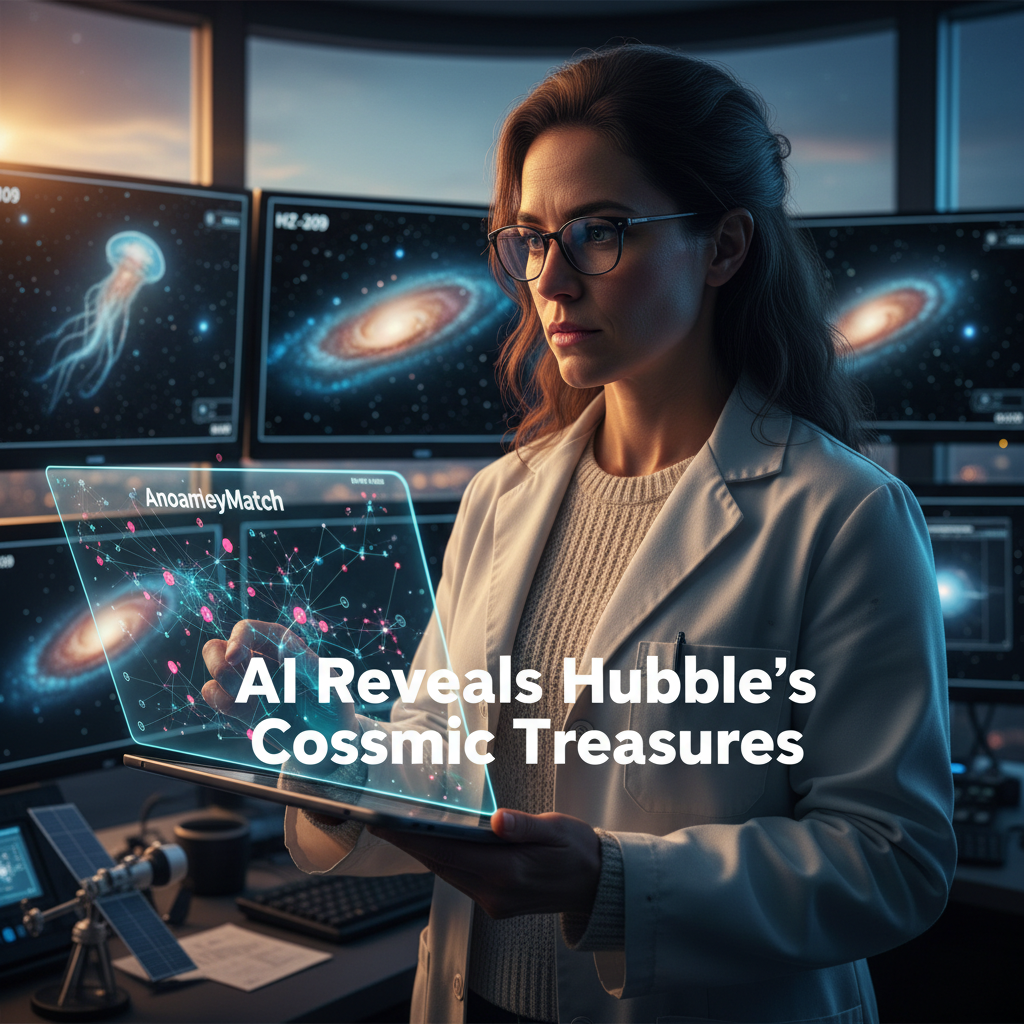
AI Discovers Hundreds of Anomalies in Hubble’s Archive
The Hubble Space Telescope, humanity’s eye in the sky for over three decades, has just revealed hidden cosmic secrets—thanks to AI. This breakthrough discovery has unveiled over 800 anomalies scattered across cosmic images, revolutionizing how astronomers analyze data from space. Discover how AI is redefining our understanding of the universe through unparalleled anomaly-detection capabilities.
The Hubble Archive: A Cosmic Treasure Trove
- Hubble’s Legacy: Since its launch in 1990, the Hubble Space Telescope has made over 1.5 million observations, storing a vast collection of 30+ years of high-resolution imagery.
- The Data Challenge: Composed of nearly 100 million image cutouts, Hubble’s archive is a daunting cosmos to explore manually, hindering swift discovery due to the slow pace of human analysis.
The AI Breakthrough: AnomalyMatch
- How It Works: Utilizing neural networks, AnomalyMatch identifies and flags anomalies, such as rare galaxy morphologies, empowering astronomers to make unexpected discoveries.
- Technical Innovation: This AI algorithm combines the power of unsupervised learning with anomaly-scoring metrics, processing terabytes of data in mere hours, offering unprecedented speed and accuracy.
- Impact on Lives: By enhancing our cosmic comprehension, AI initiatives like AnomalyMatch inspire humanity, and potentially accelerate new technological and scientific advancements.
Key Discoveries
- Cosmic Oddities: Fascinating phenomena such as over 200 galaxy mergers and 150 star-forming “jellyfish” galaxies with striking gas tails have been flagged by AI, expanding our cosmic lexicon.
- Unclassified Anomalies: AI unveils more than 100 objects that defy present astronomical categories, igniting curiosity and opening potential frontiers for scientific exploration.
- Case Studies: Remarkable findings include Object HZ-209, showcasing a black hole tugging at a neighboring galaxy, and the IC 1101 Anomaly, hinting at possible dark matter interactions.
Scientific Significance and Broader Implications
- Testing Theories: New discoveries challenge existing models of galaxy evolution and dark matter distribution, prompting a reassessment and refinement of academic theories.
- Future Missions: AI will play an essential role in upcoming projects, including the James Webb Space Telescope, enhancing our capabilities for observing and understanding the cosmos.
- Citizen Science: Platforms like Zooniverse could integrate AI to accelerate and expand the scope of public involvement in scientific discovery.
Conclusion: AI is transforming the way we explore the universe, revealing cosmic wonders that challenge our understanding and inspire future generations. Stay tuned for the unfolding journey of AI-augmented space exploration, as these discoveries mark merely the opening chapter.
TL;DR Table
| Theme | What’s Happening | Why It Matters |
|---|---|---|
| The Hubble Archive | Vast collection of space imagery | Manual analysis is slow and limited |
| AnomalyMatch AI | Automated anomaly detection in images | Revolutionizes speed and accuracy of discoveries |
| Key Discoveries | Over 800 cosmic anomalies found | Challenges and enhances our understanding of the universe |
**Focus Keyword:** AI Discovers Anomalies in Hubble Images